

Contents:
However, excessive ultraviolet (UV) radiation can cause serious damage to the skin. To assess the degree of its danger, the UV index was developed. In this article, we will discuss what it means, how UV rays affect the skin, and what protective measures are most effective.
What is the UV Index
The UV Index (UVI) is an internationally recognized system for measuring the intensity of ultraviolet radiation reaching the Earth's surface. The UV Index scale was developed in 1992 through the joint efforts of:
World Health Organization (WHO);
World Meteorological Organization (WMO);
United Nations Environment Programme (UNEP);
International Commission on Non-Ionizing Radiation Protection (ICNIRP).
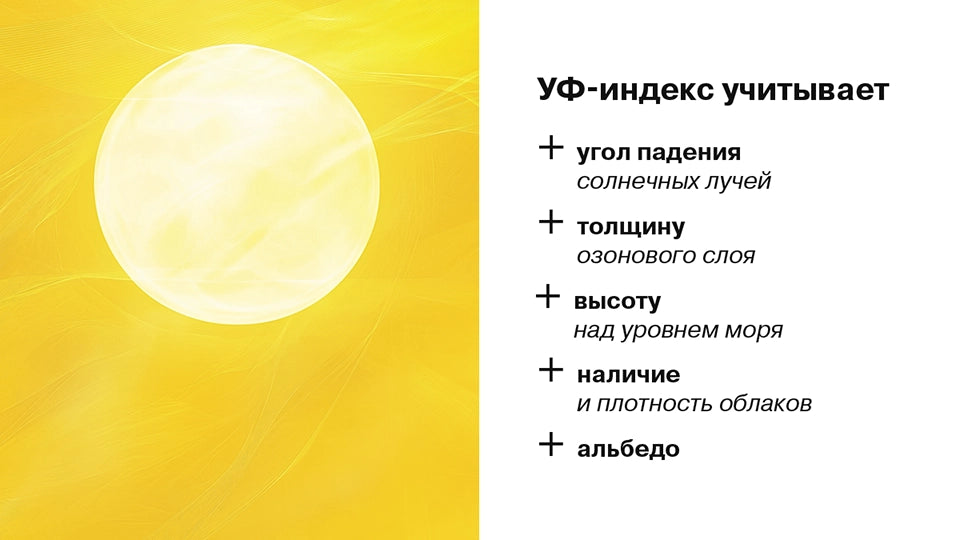
The UV index value is determined on the basis of complex calculations that take into account:
The angle of incidence of the sun's rays (maximum – at midday);
The thickness of the ozone layer (the thinner the ozone layer, the higher the UV radiation);
Altitude above sea level (every 1000 m increases UV radiation by 10-12%);
Cloudiness (thin clouds transmit up to 80% of UV rays);
Albedo (surface reflectivity):
- Fresh snow reflects up to 85% of UV rays;
- Sea foam – 25%;
- Dry sand – 15%
- Grass – 3%.
Modern technologies allow us to obtain accurate data on the current UV index level. The current indicator can be found not only in weather forecasts on television, but also in mobile applications, as well as on special websites.

How does UV radiation affect the skin?
Ultraviolet radiation is divided into three types:
UVA rays (315-400 nm) — penetrate deep into the dermis, cause photoaging, pigmentation and can contribute to the development of melanoma;
UVB rays (280-315 nm) — affect the epidermis, causing burns, tanning, and playing a key role in the development of skin cancer;
UVC rays (100-280 nm) are the most dangerous, but are almost completely blocked by the ozone layer.
If sunscreen is neglected, UV exposure has negative consequences not only for the skin, but for the entire body as a whole. UV rays cause sunburn, photoaging, the risk of cancer, and reduce local skin protection. As a result, the DNA of our cells is damaged, and the skin loses elasticity and develops wrinkles and hyperpigmentation.
Children (including those under 3 years of age), people with the first and second skin phototypes, that is, Celtic and Nordic, and people taking photosensitizing drugs (tetracyclines and NSAIDs) are especially vulnerable to UV rays.
Excessive UV exposure can also lead to chronic consequences and diseases: actinic elastosis (destruction of collagen fibers), lentigines (age spots), actinic keratosis (a precancerous condition), and melanoma and non-melanoma skin cancer.
UV radiation is beneficial only in moderate doses and with proper sun protection. It then stimulates the body's synthesis of vitamin D, which is important for bones, immunity, and metabolism.
UV Index Scale
| UV Index | Category | Time to Burn* | Protective Measures |
|---|---|---|---|
| 0-2 | Low | >60 min | Protection is not necessary, but for sensitive skin, use SPF 15+. |
| 3-5 | Moderate | 45-30 min | Use sunscreen (SPF30+), wear sunglasses, and a hat. |
| 6-7 | High | 30-20 min | Limit sun exposure between 11:00 AM and 4:00 PM, use SPF50+. |
| 8-10 | Very high | 20-10 min | Stay in the shade, wear protective clothing, and reapply cream every 2 hours. |
| 11+ | Extreme | <10 min | Maximum protection: Avoid sun exposure during peak hours, use a water-resistant SPF. |
In Russia, the UV index rarely exceeds 8, but in the southern regions and mountainous areas (Crimea, the Caucasus, Altai) it can reach 9-10.
Always remember the geographical features in which you are:
Equatorial regions: constant index of 10-12;
High mountains: +10% UV radiation for every 1000 m of altitude;
Snowy regions in winter: reflection doubles the UV load.
How to protect your skin from ultraviolet radiation
Use sunscreen.
Choose products and SPF factor based on the UV index level and your current location. Check the forecast in weather apps and adjust your sun protection. It is best to use products with SPF 30-50+.
Also remember to pay attention to the PA++++ marking — the UVA protection factor. Apply the cream 15-20 minutes before going outside and reapply every 2 hours (or after swimming).
Wear protective clothing and accessories.
Hats with wide brims, sunglasses with a UV filter, clothing made of dense fabrics with UPF protection.
Avoid the sun during peak hours.
It is better to limit your time in the sun from 10 am to 4 pm, especially in the equatorial zone. During this period, solar activity and UV radiation are most intense.
Take care of your skin after sunbathing.
Apply moisturizing and restorative products with panthenol, hyaluronic acid, ceramides, and antioxidants (vitamins C, E, ferulic acid) to neutralize free radicals.
Understanding the UV index is not just about caring for the beauty of your skin, but an important aspect of preventing serious diseases. Modern science offers many ways to protect yourself: from high-tech sun filters to smart clothing with UPF.
We recommend checking the UV index daily, choosing protection according to the radiation level, and combining different photoprotection methods.